Google Sheets Works Well - Until It Carries Too Much
Many companies start with spreadsheets for good reasons. Google Sheets is easy to open, easy to change, fast to share, and flexible enough to support a process without a long implementation phase.
That is exactly why spreadsheets often stay in the business for years. Teams use them for clients, sales, stock, calculations, invoices, purchases, planning, and internal reporting.
The problem does not begin when a company uses Google Sheets. It begins when a spreadsheet is already acting like a full business system without offering the control, visibility, and structure of one.
Why Teams Keep Choosing Spreadsheets
If a better system is going to replace or extend a spreadsheet workflow, it first needs to respect what made that workflow useful.
Fast to Start
No long rollout is required. A sheet can be created today and used immediately.
Flexible Formulas
Each sheet, column, and formula can be adapted to the way the business actually works.
A Familiar Interface
People already understand how to edit rows, copy values, and work with a tabular structure.
Quick Changes
When the process changes, the workflow can often be adjusted without waiting for a software release.
When Convenience Starts Becoming Expensive
One or more spreadsheets gradually become the center of daily operations.
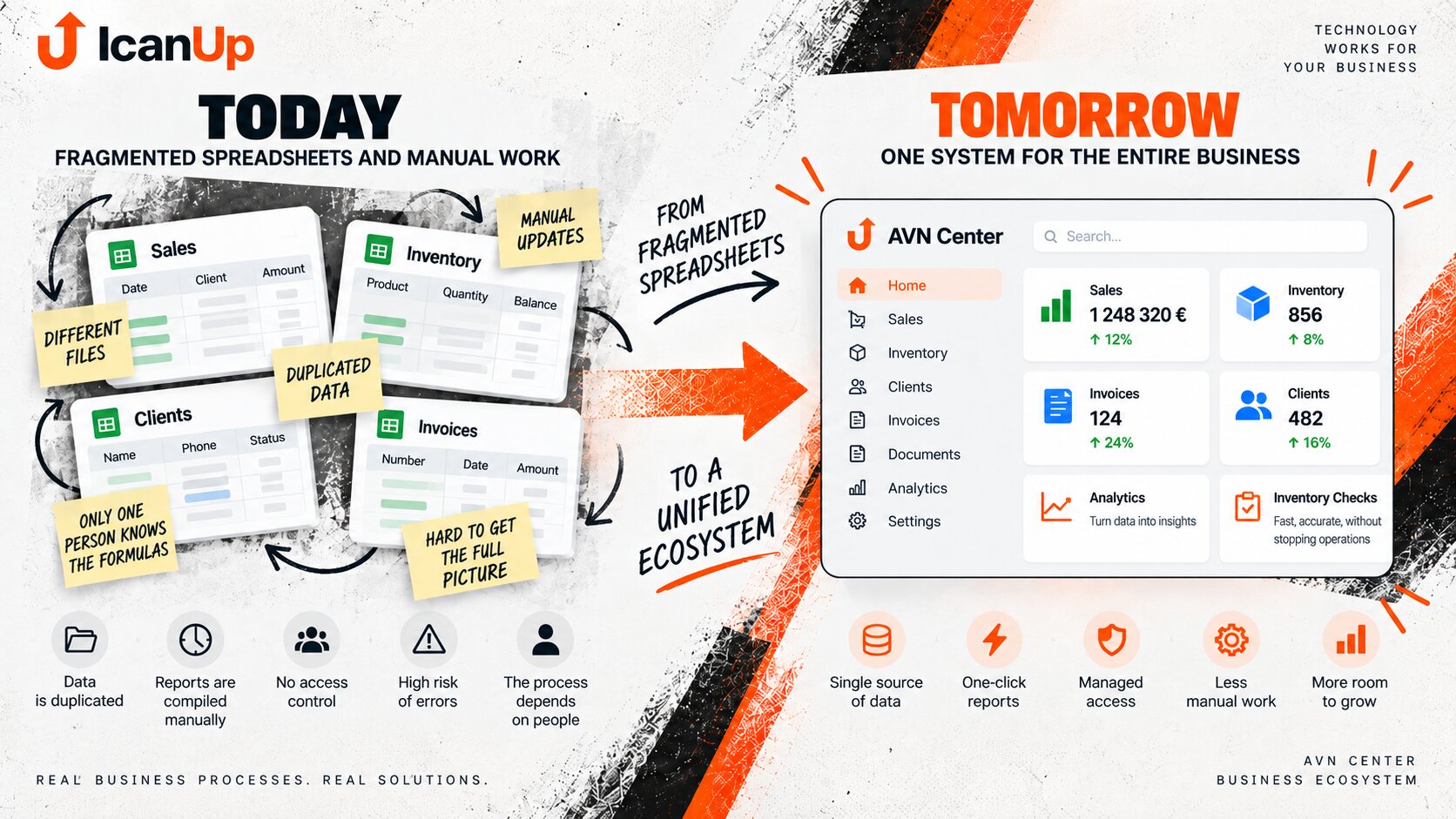
Data is copied between sheets, reports are rebuilt manually, critical formulas are known by one person, and checking the current state of stock or performance numbers becomes harder over time.
The business needs a system that preserves the useful logic while giving data a shared structure, improving control, and making reporting, documents, and analytics work on the same foundation.
Signals That Spreadsheets Are No Longer Enough
The issue usually appears not as one dramatic failure, but as several limits accumulating at the same time.
Data Is Repeated
The same values appear in different files or tabs, and updates need to be moved manually.
Reporting Is Manual
To see sales, stock, or financial performance, someone has to reconcile and rebuild the picture by hand each time.
Access Control Becomes Weak
It starts to matter who can see, edit, or remove information, and spreadsheets become a fragile way to manage that.
The Workflow Depends on Specific People
Critical formulas, checks, or process rules are known by one person, which makes the workflow brittle.
When a spreadsheet becomes the heart of daily operations, the business usually needs more than another tab. It needs a more coherent environment.
What Should Not Be Lost in the Transition
A common mistake in replacement projects is removing everything familiar and calling that progress. But if spreadsheets became central to the workflow, they clearly solved real needs.
The transition should not begin with "now everything will work differently". It should begin with understanding what needs to be preserved and reinterpreted inside a better system.
Four Things a Better System Often Needs to Preserve
A stronger system should not only add control. It should also remain practical for everyday work.
Fast Editing
People are used to changing values quickly, copying rows, and working without unnecessary friction.
The Logic of Existing Formulas
If the business depends on calculations built over years, those calculations need to be understood and preserved in the new logic.
A Clear Data Structure
Information still needs to be easy to find and understand, not buried inside a complex interface for the sake of modernity.
A Controlled Transition
The move should happen gradually, with data and workflows being validated instead of switching everything off in one step.
What Businesses Usually Need Beyond Spreadsheets
This is the point where the company stops looking for just another interface and starts looking for new capabilities.
Analytics
Performance metrics should be built automatically from working data instead of manually assembled from multiple files.
Inventory and Stock Control
Movements, checks, balances, and operational history need to become visible and controlled.
Invoices and Documents
Documents should be generated faster, remain editable where needed, and reuse data instead of requiring repetitive entry.
History and Roles
The business needs to know who changed what, when it happened, and which parts of the data different people should be allowed to access.
A Short Business Summary
Questions That Usually Come Next
A few short answers for companies that recognize themselves in this situation.
What if much of our work still happens in Google Sheets?
Does this mean spreadsheets should be removed immediately?
What do companies usually want beyond spreadsheets?
Can the transition happen gradually?
If Your Business Is Outgrowing Spreadsheets, I Would Like to Hear About It
Tell me how spreadsheets fit into your current workflow, what they still do well, where they create friction, and which capabilities would make the biggest difference for your business.