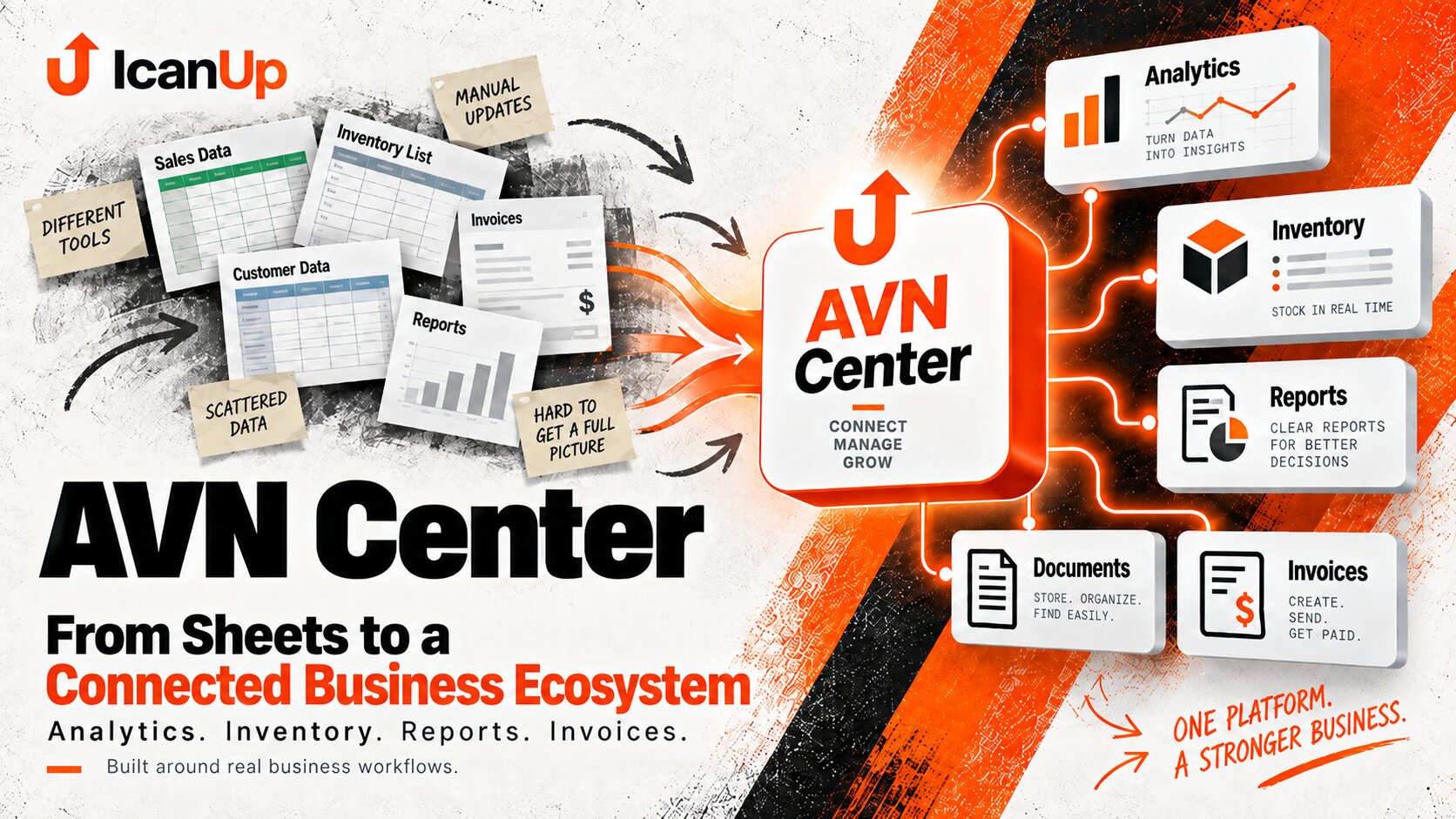
Business Software Should Fit the Way Your Company Works
Companies start from very different places. One may already depend on several specialized platforms. Another may run a large part of its operations in Google Sheets or Excel. Some teams use established accounting or operational software but still prepare reports, invoices, inventory checks, or management analytics manually.
I do not see those workflows as something to dismiss. They show what people already understand, what has become efficient through habit, and where the real friction begins.
AVN Center is one product direction where I am applying this thinking. The same approach also shapes how I look at custom business systems: understand the operation first, then build around the company instead of forcing the company into a generic template.
Every Business Has a Different Starting Point
Before designing a new system, I want to understand what actually keeps the operation running today.
Google Sheets or Excel
Spreadsheets may already function as a real business system, with formulas, stock calculations, reporting, and fast editing that people know well.
Legacy or Familiar Business Software
Employees know the document flow, data structure, and shortcuts. Replacing the interface should not automatically mean losing that efficiency.
Several Disconnected Tools
Sales, inventory, accounting, documents, and analytics may live in separate products while people move data between them manually.
Manual Workflows
Important processes may still depend on files, messages, documents, and knowledge held by individual team members.
What a Custom Business System Can Add
The value is rarely one universal feature. Different companies need different parts of their operation to become easier, safer, or more visible.
Analytics and Reporting
Operational and management data can become available directly from the system instead of being rebuilt manually from several files.
Inventory and Operations
Stock, movements, inventory checks, and operational history can become part of one controlled workflow.
Invoices, Reports, and Documents
Documents can be generated faster, edited where necessary, and populated from existing business data without repetitive manual entry.
Custom Rules and Integrations
Calculations, approvals, country-specific document flows, external services, and unusual business rules can be designed around the actual operation.
The Goal Is Not a New Interface for Its Own Sake
Data may be spread across spreadsheets, legacy software, email, and separate SaaS tools.
Reports are rebuilt manually, inventory is checked elsewhere, and important process rules may exist only in people's experience.
A custom system brings the useful workflow into one controlled environment without discarding the parts people already understand.
Analytics, inventory, documents, permissions, and history can work on top of a shared data model.
How I Approach Custom Business System Development
The goal is not a dramatic switch from old to new. It is a controlled transition designed around the operation.
Understand the Real Workflow
Map the tools, spreadsheets, documents, roles, data, and process rules that actually keep the company running.
Preserve What Is Valuable
Keep familiar patterns, critical data, and efficient ways of working when they genuinely help the team.
Build Around the Missing Capabilities
Add the analytics, inventory, documents, reporting, automation, integrations, and business rules the company actually needs.
Migrate, Validate, and Roll Out Gradually
Move data and processes in controlled stages, validate the result with the business, and switch only when the new part is ready.
Business Software Is Not a Quick SaaS Project
Code Is Only the Beginning
Once a real company depends on a system, the quality of the product is defined by much more than its feature list.
Security and Access
Roles, permissions, and data protection need to reflect real responsibilities inside the company.
Data and History
Data integrity, backups, auditability, and predictable change become part of the product, not optional extras.
Integrations and Migration
Existing data sources, external services, and a safe transition path need to be considered from the beginning.
Long-Term Evolution
After the first release, the system still needs support, adaptation, and continuous development as the business changes.
The difficult part is not building the first version. It is building a system a company can rely on while its real operation keeps moving.
Built Around Your Market, Not Mine
For international companies, I do not assume that Ukrainian business rules, document formats, or operational habits should simply be copied into another market.
A custom system can be designed around the company’s own terminology, workflows, document formats, currencies, reporting needs, integrations, and local operating conditions. Where accounting, tax, legal, or regulatory rules matter, those requirements should be defined together with the client and, when needed, their local accounting or legal specialists.
The goal is not to sell the same system everywhere. It is to build software that reflects how the specific business actually operates.
ICanUp Is Moving Into Its Next Stage Too
If you have followed ICanUp for some time, much of the content here has been technical: Laravel, PHP, Vue,, architecture, security, analytics, automation, and documentation. That will continue.
But the goal has never been to rewrite framework documentation. I want to document real development: decisions, trade-offs, failures, improvements, and the way larger systems emerge from smaller technical choices.
The next question is no longer only "How can this be implemented?" It is also "What is worth building, and how should it work for a real business?"
A good business system does not start with a list of modules. It starts with understanding how people work today and what would make that work better tomorrow.
Working With Companies Outside Ukraine
AVN Center is one product direction, while custom development can be adapted to a company’s own market and operating conditions.
Is AVN Center an off-the-shelf product I can buy today?
Can you build a custom business system for a company outside Ukraine?
Do we have to replace our current tools immediately?
Can familiar spreadsheet or legacy-system workflows be preserved?
What happens to information about our company?
Need a System Built Around Your Business?
If generic software does not fit your workflows, I can discuss a custom business system designed around your operations, data, reporting, integrations, documents, and local requirements.