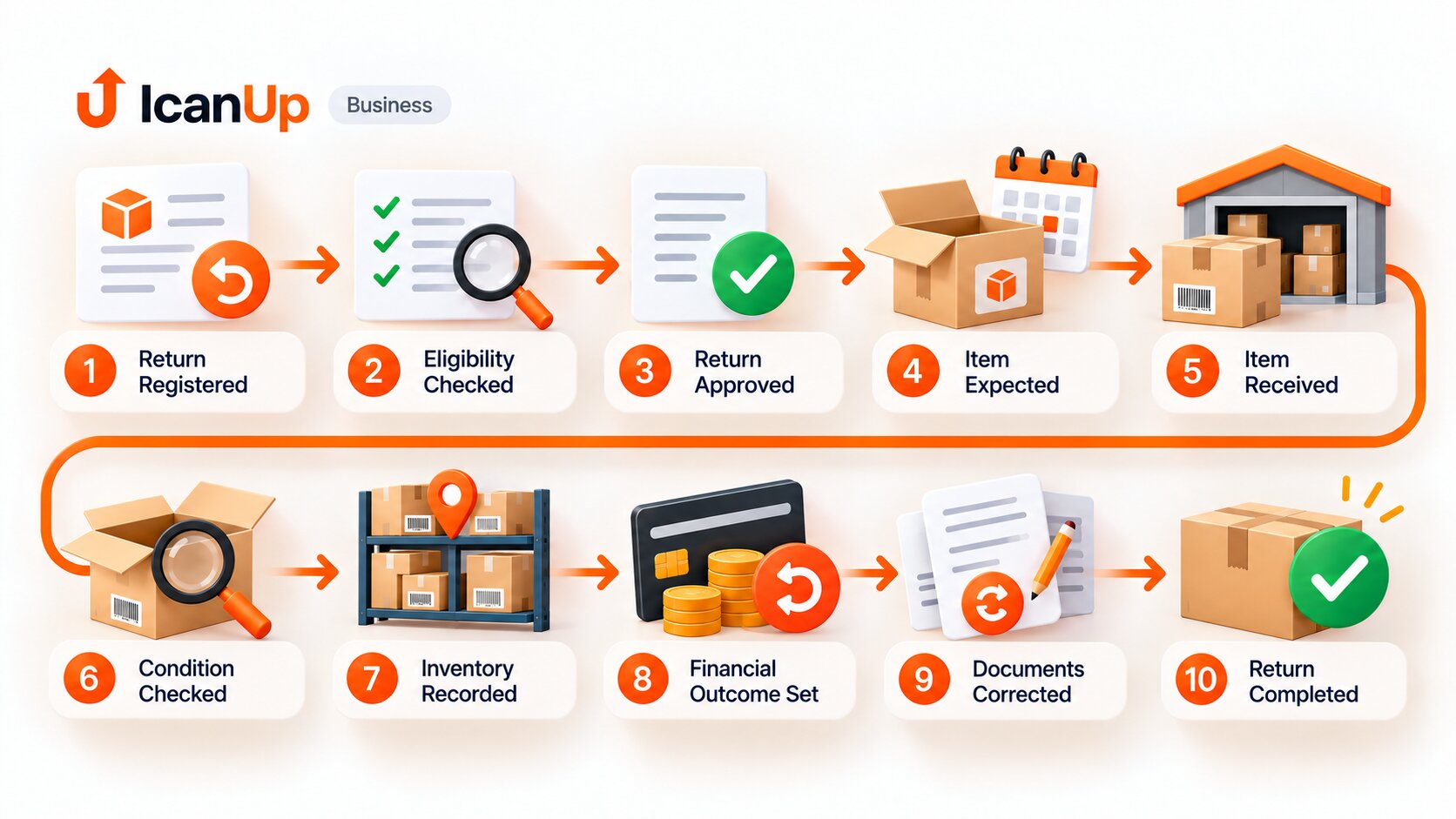
A Product Return Is Not Simply the Sale Running Backward
A sale usually has a clear direction: order, payment, warehouse, shipment.
A return is more complex because several states are affected at once.
A customer may request a return while the product has not physically arrived yet. Only part of an order may be returned. The item may be undamaged, damaged, or unsuitable for resale. Payment may have been full, partial, or made through another channel. Accounting documents may already have been processed.
If every department corrects its own part independently, it becomes easy to reach a situation where the warehouse has already increased stock, accounting has not yet made the correction, and sales has already promised the customer a refund.
What I Would Capture Before the Item Physically Returns
A return should have its own context instead of beginning with a request to "put the item back into stock".
Which Sale the Item Belongs To
The order, document, or other reference that shows when and under which terms the item was delivered to the customer.
What Is Being Returned
The exact item, quantity, and where needed a serial number, batch, or another identifier.
Why It Is Being Returned
The reason may affect the next decision: picking error, damage, customer cancellation, or another case.
What We Expect to Receive
The declared quantity and expected condition are not yet facts. They only describe the planned return.
What the Customer Expects
A refund, replacement item, credit toward another order, or another agreed outcome.
Who Owns the Decision
It should be clear who can approve an exception, adjusted amount, or another non-standard scenario.
How I Would Design the Main Return Flow
I would clearly separate the customer’s intention to return an item, the physical receipt of the item, and the financial outcome.
Return Registered
Record the customer, original sale, items, quantities, reason, and expected outcome.
Eligibility and Conditions Checked
Validate company rules, original sale, timing, quantity, and other conditions that affect the return scenario.
Return Approved or Rejected
The decision becomes part of the process. If an exception is needed, the responsible person is recorded.
Item Expected
An approved return does not yet change physical inventory. The system only knows that the item is expected back.
Warehouse Received the Item
Record the actual quantity and the fact of physical receipt.
Item Condition Checked
Determine whether it can return to available stock or needs separate storage, repair, write-off, or another decision.
Inventory Movement Recorded
Inventory changes according to the actual quantity received and the decision about the item condition.
Financial Outcome Determined
Confirm the refund amount, replacement, credit, or another agreed outcome.
Documents Corrected
Required accounting and internal documents are created from the actual return instead of separate manual entry.
Return Completed
Product, money, documents, and customer outcome now have a consistent final state.
| Declared | Actually Received | What Should Happen |
|---|---|---|
| 5 units | 5 resellable units | 5 can return to available stock |
| 5 units | 4 units | Process 4 actual units while the difference remains open |
| 5 units | 5, one damaged | 4 to available stock, 1 to a separate condition |
| 1 unit | Different item | Do not increase stock for the expected item |
| 2 units | Not received yet | Do not change physical inventory |
I would not use the rule "return equals put it back into stock".
After receipt, one item may return to sale. Another may require inspection. A damaged item may move into a separate state. A wrongly shipped item can return while the correct one is sent to the customer. In some cases, the physical item may not return at all while a financial correction is still required.
The return itself and the later disposition of the item are therefore different things.
The warehouse should record what it actually received, not what someone expected it to receive.
The most important questions are not about the perfect return but about exceptions.
What happens if the customer declares 5 units but returns 4? If an item is damaged? If the normal return period has passed but a manager approves an exception? If only part of the amount should be refunded? If the customer wants a replacement instead of money? If one component of a set is missing?
If these situations happen regularly, they should not be resolved by manually editing inventory and documents.
They deserve clear outcomes inside the process.
A Few Questions About Product Returns
The main principle is to keep the requested return, actual receipt, and financial outcome separate.
Should inventory increase immediately after a return is approved?
What if the returned product is damaged?
Can the refund amount differ from the original product value?
What about a partial return?
Must a refund always wait until the item is physically received?
Where should improvement begin?
How I Would Design This Business Process
In this series, I break real business processes into facts, decisions, ownership, and exceptions to show where a system can remove manual data correction.

Do Returns in Your Business Also Mean Correcting Several Systems Manually?
Start with one real case: what the customer requested, what the warehouse actually received, who made the decision, how inventory changed, and where accounting got the refund amount. That path often reveals exactly where the process breaks.