Three Different Numbers Can All Be Correct
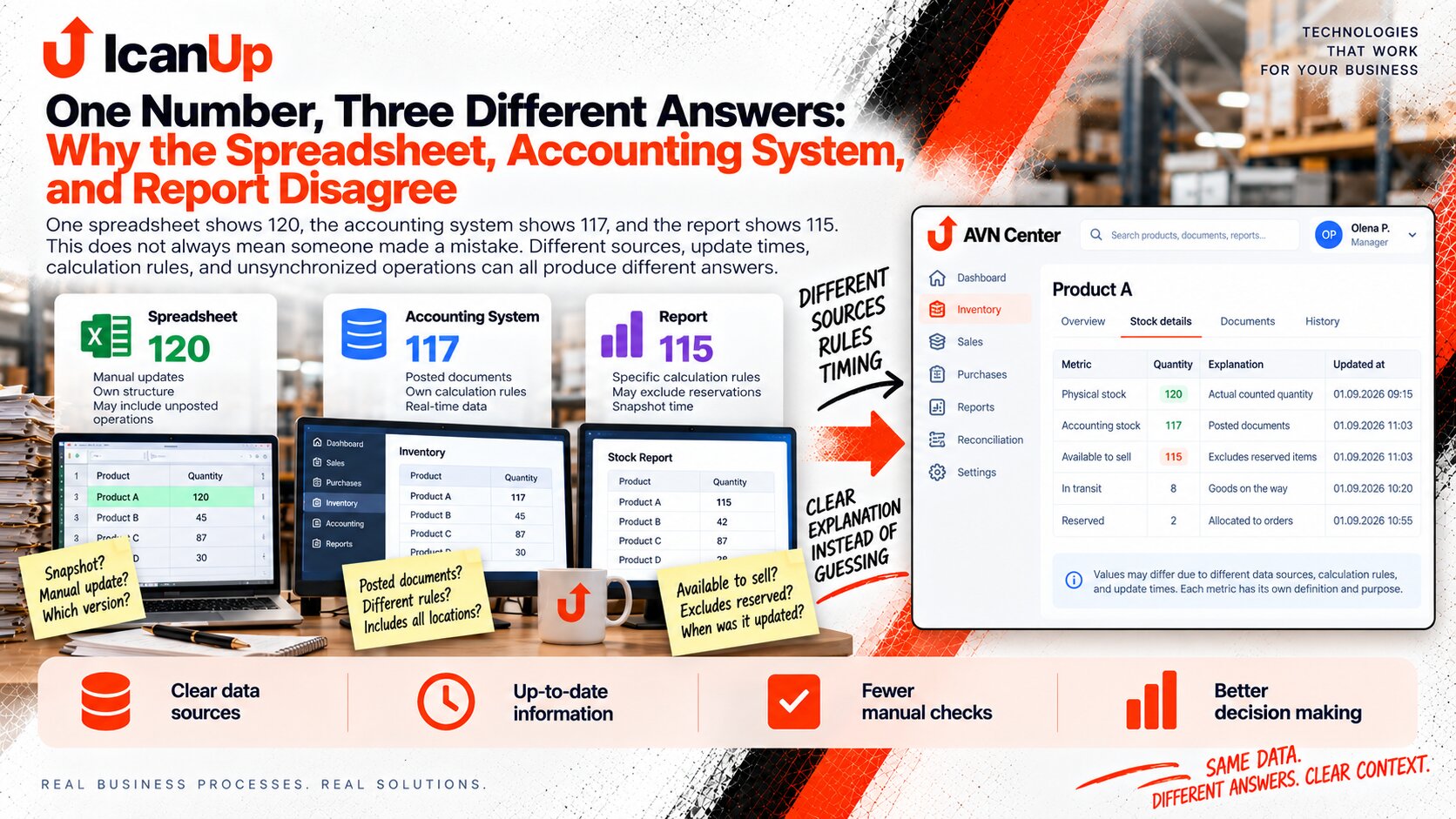
Imagine a simple situation. A manager opens a spreadsheet and sees 120 units. The accounting system shows 117. A management report shows 115.
The familiar investigation begins: who changed the data, which number is correct, whether the file is current, whether all documents were posted, and when the report was last refreshed.
After half an hour, the team may discover that none of the systems is broken.
The spreadsheet was updated in the morning. The accounting system already includes new operations. The report calculates only stock available for sale and excludes reserved items.
The problem is not always an incorrect number. Often the problem is that the number has lost its context.
Why One Number Becomes Several Different Answers
Before looking for an error, it helps to understand what each value actually represents.
Different Sources
A spreadsheet may be an independent copy, accounting uses its own documents, and a report may read from another data store.
Different Data Freshness
One value was updated a minute ago, another overnight, and a third may still represent yesterday.
Different Rules
Physical stock, available stock, and accounting stock can be different business concepts.
Not Every Operation Is Synchronized Yet
A document may already exist in one system but has not yet been transferred, posted, or included in reporting.
| Metric | What It May Mean | Why the Number Differs |
|---|---|---|
| Physical stock | What is physically present | Represents actual counted quantity |
| Accounting stock | What posted documents record | Depends on completed accounting operations |
| Available to sell | What can still be promised to customers | May exclude reservations |
| Reported stock | Value according to report rules | May use its own filters and snapshot time |
| Spreadsheet stock | A copy or working value | May depend on manual updates |
The number 117 means very little without additional context.
117 of what? In which warehouse? At what moment? Before or after reservations? Are goods in transit included? Were all documents posted? Are returns included? Is this physical, accounting, or available stock?
The more systems a business uses, the more important these questions become.
A good report should therefore show not only a value but enough context for a person to understand what that value actually represents.
How to Resolve Different Numbers Systematically
The goal should not be to make every number identical. Start by defining what each metric actually means.
Name the Business Concept
Identify whether the number represents physical stock, accounting stock, available stock, reservations, or another metric.
Define the Source of Truth
For each concept, there should be one system that owns its authoritative state.
Define the Calculation Rules
Make it clear which operations are included in the metric and which are excluded.
Include Data Freshness
Users should know the moment represented by the number and when its source was last updated.
Describe Synchronization
Understand which data moves immediately, which arrives later, and what happens when synchronization fails.
Remove Unnecessary Copies
If the same number is manually maintained in several places, check whether every copy is genuinely required.
Explain Discrepancies
When two values are legitimately different, the system should help users understand the reason.
A spreadsheet is not a problem by itself.
It can be an excellent tool for analysis, planning, or temporary work. The problem begins when a copied dataset quietly becomes another independent source of truth.
For example, stock is exported in the morning. Sales and receipts continue in the accounting system, but employees still make decisions from the morning file.
The question is not whether Excel or Google Sheets should be banned. The more important distinction is: is this a live system or a snapshot from a specific moment?
A Few Questions About Different Numbers Across Systems
Not every discrepancy is an error, but every discrepancy should have an understandable explanation.
Should one number always be identical everywhere?
What is a source of truth?
Why is the update time so important?
Can a report show a different number and still be correct?
Do all spreadsheets need to disappear?
What if synchronization is delayed?
AVN Center: From Business Needs to Product
This series explores situations where the visible problem looks like a wrong number, an extra spreadsheet, or another manual check, while the deeper issue is often the structure of data and the business process behind it.

Every Number Should Have a Clear Origin
In the approach behind AVN Center, the goal is not simply to collect all data in one place. It is important to define who owns the state, how it changes, when it is updated, and why the user sees a particular value.