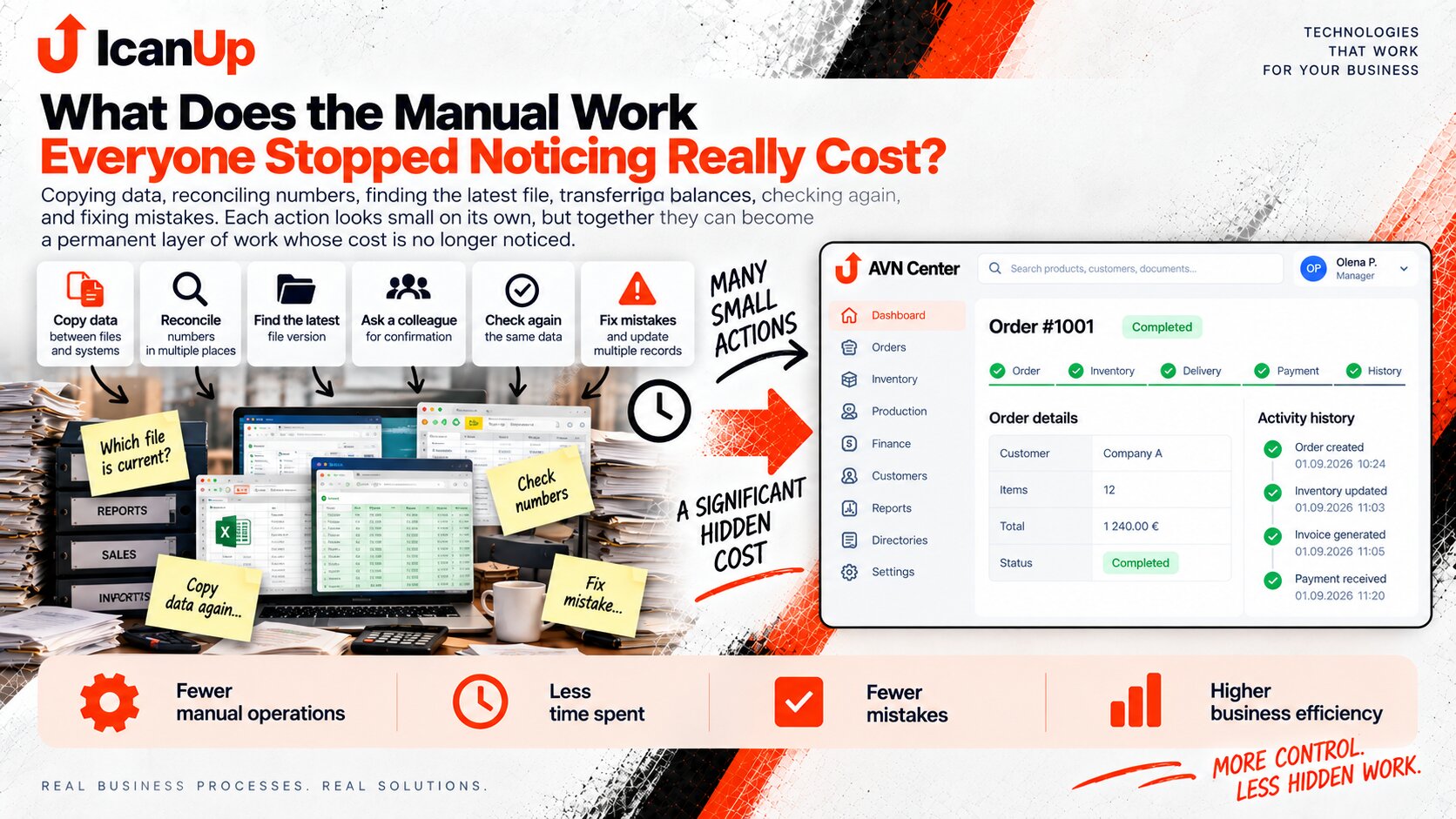
The Most Expensive Manual Work Often No Longer Looks Like a Problem
When businesses think about cost, salaries, rent, equipment, logistics, and software subscriptions are usually easy to see.
The work hidden inside an ordinary day is much harder to notice.
An employee opens one file, finds a row, copies a number into another system, checks the total, asks a colleague whether this is the latest version, and continues working. It may take only a few minutes.
The problem is that the same sequence happens tomorrow. And the day after that.
One small manual action means very little. A continuous stream of those actions becomes a process of its own.
Manual Operations That Easily Become Invisible
Individually they rarely look serious. Together they often form a large part of everyday operational work.
Copy Data
Move a customer, amount, document number, stock balance, or another value from one place to another.
Reconcile
Check whether numbers match across two spreadsheets, systems, or documents.
Find the Current Version
Determine which file is the latest and whether someone has already changed another copy.
Transfer Balances
Update data manually after a sale, inventory count, receipt, or another operation.
Check Again
A person does not fully trust the result, so they verify again what the system should already guarantee.
Fix the Consequences
An error in one manual step may need to be discovered and corrected across several later operations.
| Manual Action | What Is Actually Spent | What Can Go Wrong |
|---|---|---|
| Copy data | Time and attention | Transfer error |
| Reconcile two systems | Time across two data sources | Unclear source of truth |
| Find the latest file | Time and communication | Work continues from an old version |
| Ask a colleague | Time from two employees | Waiting for a response |
| Check again | Time and concentration | The same result is verified repeatedly |
| Correct an error | Time for investigation and recovery | The error may already affect later work |
How to Find Manual Work That Has Become Invisible
I would not start by asking what to automate. The first step is to see the real path information takes through the business.
Choose One Ordinary Operation
For example, an order, receipt, payment, inventory count, or report preparation.
Follow the Entire Process With an Employee
Observe which files are opened, where data is copied from, who is contacted, and what is checked manually.
Mark Repeated Data Entry
Every place where known information must be entered or copied again is a candidate for simplification.
Find Manual Checks
If an employee repeatedly verifies something that software could validate automatically, that check is a separate hidden operation.
Find Waiting
Look not only at active work but also at pauses: waiting for a file, approval, answer, or updated information.
Look at Errors and Rework
If one wrong value forces several previous steps to be repeated, the cost of the manual action is much larger than the entry itself.
Repeat for the Most Frequent Processes
There is no need to map the entire company at once. A few high-frequency operations can already reveal a systemic pattern.
The hidden cost of manual work is not limited to the time required for the original action.
If a number is transferred incorrectly, someone has to notice the error. Then the team needs to find where it happened, check which later operations used the incorrect value, correct the data, and sometimes tell other people that previously shared information was wrong.
One minute of manual entry can therefore create a much longer chain of work.
The most expensive part is often not the mistake itself, but the inability of the system to quickly answer: who changed the data, when it happened, what the previous value was, and where that information has already been used.
A Few Questions About Hidden Manual Work
It does not need to be converted into money immediately for the problem to become visible.
Do we need to calculate the cost of every minute?
Is copying one field really a problem?
Should every manual action be automated?
Why is finding the latest file also a cost?
Where should improvement begin?
AVN Center: From Business Needs to Product
This series looks at ordinary daily processes that often feel normal but can reveal where a business needs a better connection between data, people, and operations.

Automation Starts With What We Finally Begin to Notice
For me, AVN Center does not begin with a list of features to build. The first step is to see the real work: where data is duplicated, where people reconcile systems manually, where information is awaited, and where teams repair consequences that could have been detected earlier.