Not Every Business Needs Custom Software
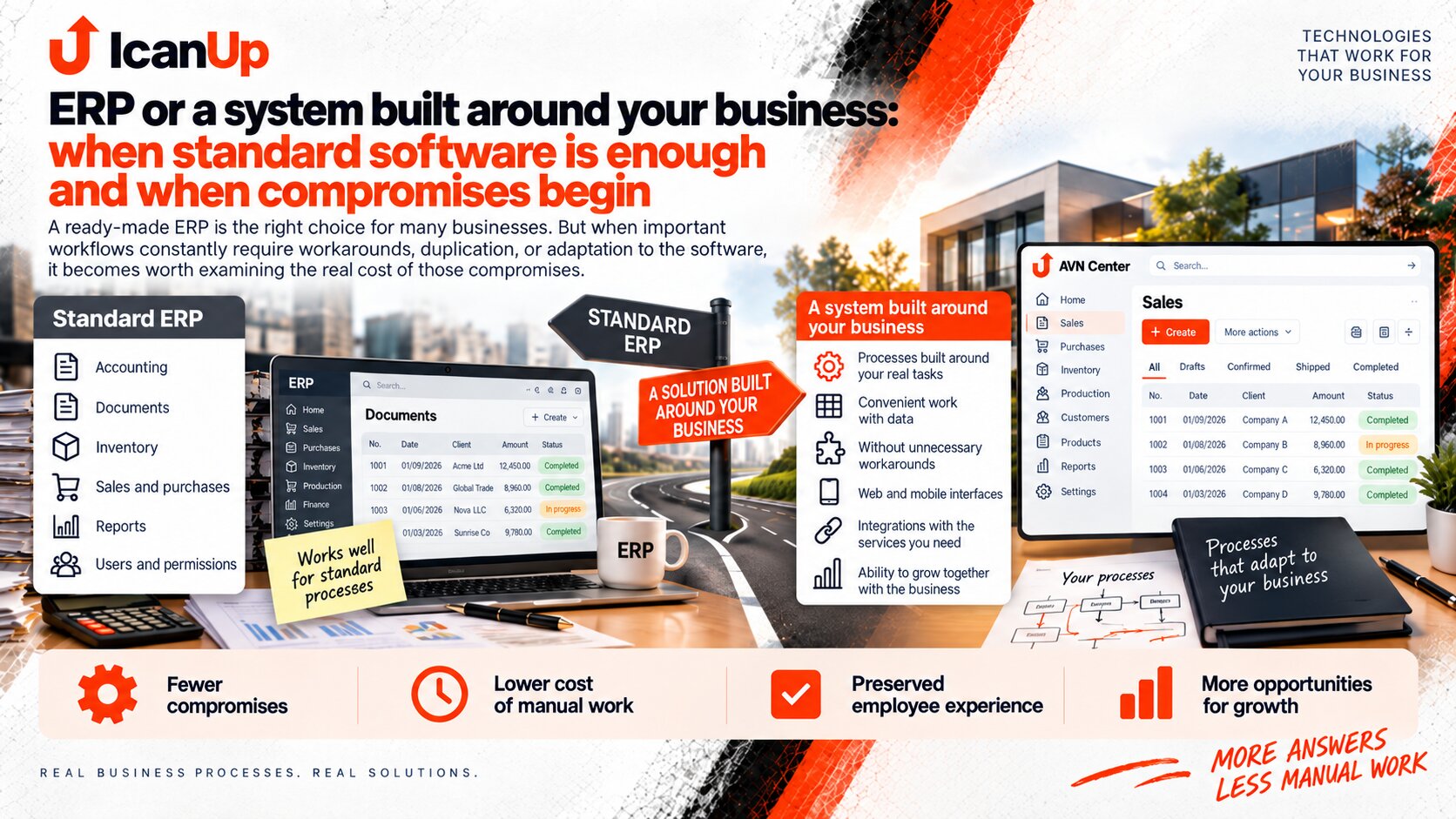
When people discuss software built for a specific business, it is easy to begin with the advantages of custom development. I think an honest discussion should start somewhere else: in many cases, a ready-made ERP really is the right answer.
It already provides accounting, documents, permissions, inventory, sales, purchasing, reporting, and many other capabilities that would otherwise need to be built from scratch.
If a business operates in roughly the same way as thousands of other companies, there may be little value in spending years rebuilding standard processes.
The decision becomes more interesting when the software technically supports a function, but the real company workflow repeatedly has to be simplified, bypassed, or maintained in parallel tools.
When a Ready-Made ERP Is Usually a Good Choice
Standard software is strongest when standard processes genuinely match the business.
The Processes Are Common
Sales, purchasing, inventory, finance, and documents operate similarly to many other companies.
Speed of Adoption Matters More
The company needs to begin working now rather than wait for a large system to be built from scratch.
Uniqueness Adds Little Value
A special way of handling a standard operation does not create a meaningful business advantage.
The Team Can Adapt the Process
A small internal workflow change costs less than building and maintaining a separate solution.
When Compromises Start Accumulating
One workaround does not mean a company needs custom software. But repeated compromises should eventually be treated as a real operating cost.
Duplicate Data Entry
Information appears in one system first and then has to be manually entered into another.
Critical Spreadsheets Outside the System
An important part of the workflow lives in Excel or Google Sheets because the ERP does not represent how the company actually works.
Rules Live in People’s Memory
The software does not enforce an important exception, so the correct result depends on whether an employee remembers it.
Work Happens Around the System
Employees create their own files, chats, notes, and intermediate steps just to complete what should be a normal operation.
| Situation | Ready-Made ERP | Business-Specific System |
|---|---|---|
| Standard accounting | Usually a strong choice | Often not worth rebuilding separately |
| Fast adoption | Major advantage | Requires more time |
| Standard documents | Already available | Need to be implemented |
| Unique critical workflow | May require compromises | Can closely reflect real operations |
| Frequent exceptions | Workarounds can accumulate | Rules can become part of the system |
| Maintenance | Much of it is handled by the vendor | The company owns product development |
| Initial cost | Usually lower | Usually higher |
How I Would Evaluate the Decision
The decision to build custom software should begin with the real cost of the current process, not with technology.
Separate Standard From Specific
Identify which workflows are common across many companies and which ones genuinely distinguish this business.
Find Every Workaround
Collect spreadsheets, manual transfers, extra checks, chats, intermediate files, and rules that currently live outside the main system.
Measure Their Cost
Estimate time, mistakes, delays, dependency on specific employees, and difficulty of control.
Check Configuration and Integrations First
The problem may be solvable through ERP configuration or a focused integration without creating an entirely new product.
Find the Highest-Value Workflow
Even when custom logic is justified, replacing everything may not be necessary. Start where the current compromise costs the most.
Compare More Than the Initial Cost
Custom software requires long-term development, maintenance, security, upgrades, and responsibility for the product.
There is a large space between a completely standard ERP and a completely custom platform.
A company can keep standard accounting in an existing product while separately automating the workflow that creates the most friction. It can add an integration, a dedicated workspace, a mobile interface, or a service that owns one specific part of the operation.
This is an important principle for me: there is no need to rebuild the entire business just because one process does not fit a standard product.
At the same time, there is no reason to maintain dozens of manual workarounds for years simply because the company once chose an off-the-shelf system.
A Few Questions About ERP vs Custom Software
There is rarely one universal answer. The decision should be based on real workflows and their cost.
When is a ready-made ERP completely sufficient?
Do a few Excel files mean custom software is needed?
What matters more than the number of unusual processes?
Does an ERP need to be replaced completely?
What is the main risk of custom software?
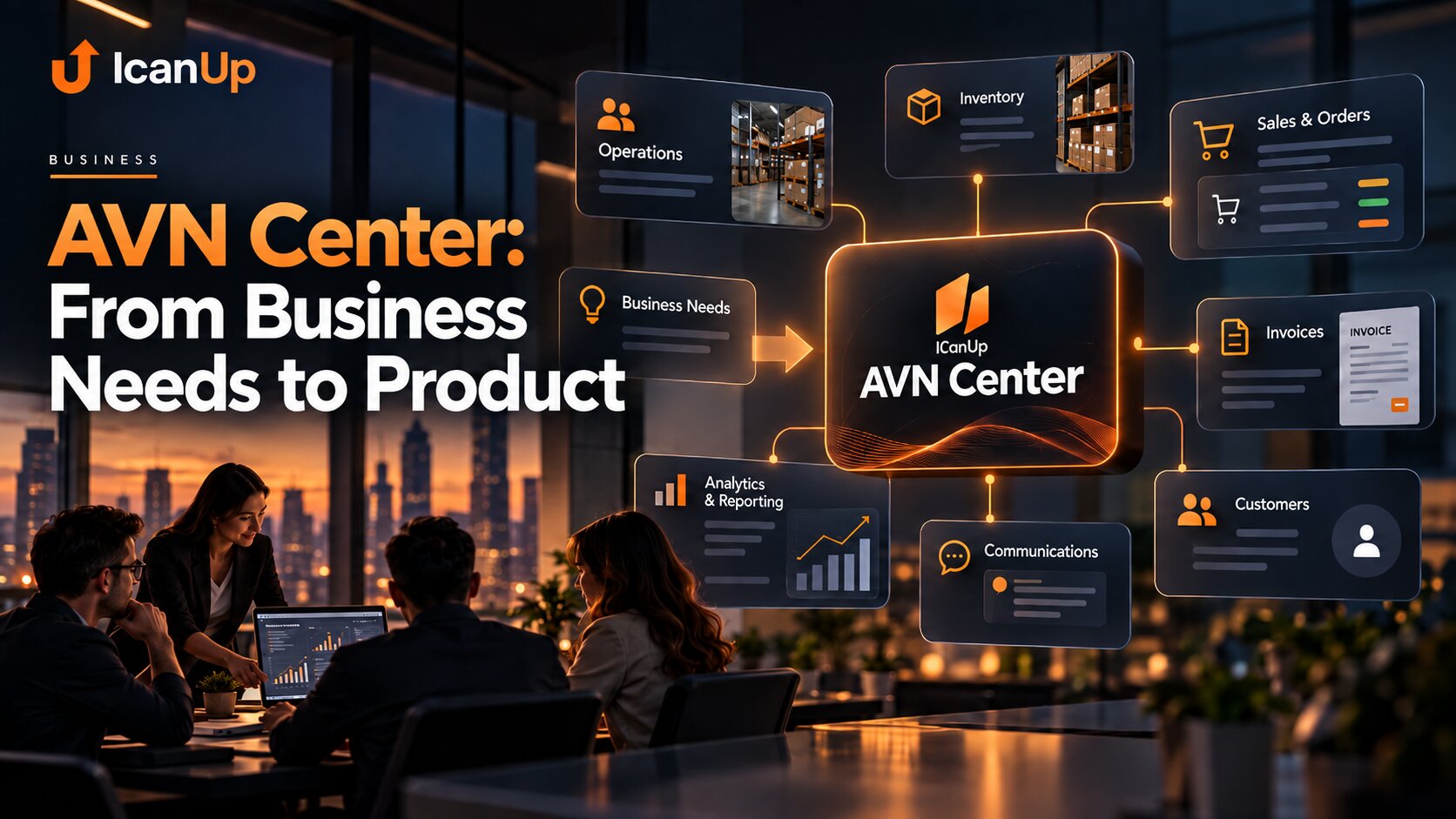
AVN Center: From Business Needs to Product
This series explores real workflows and compromises that help reveal where standard software is enough and where a business may need a different operating model.
Do Not Start With "What Should We Build?"
For me, the work behind AVN Center starts with a different question: where does standard software already serve the business well, and where do real workflows create enough friction to justify a better solution? Not everything needs to be replaced, but permanent compromise should not become normal.