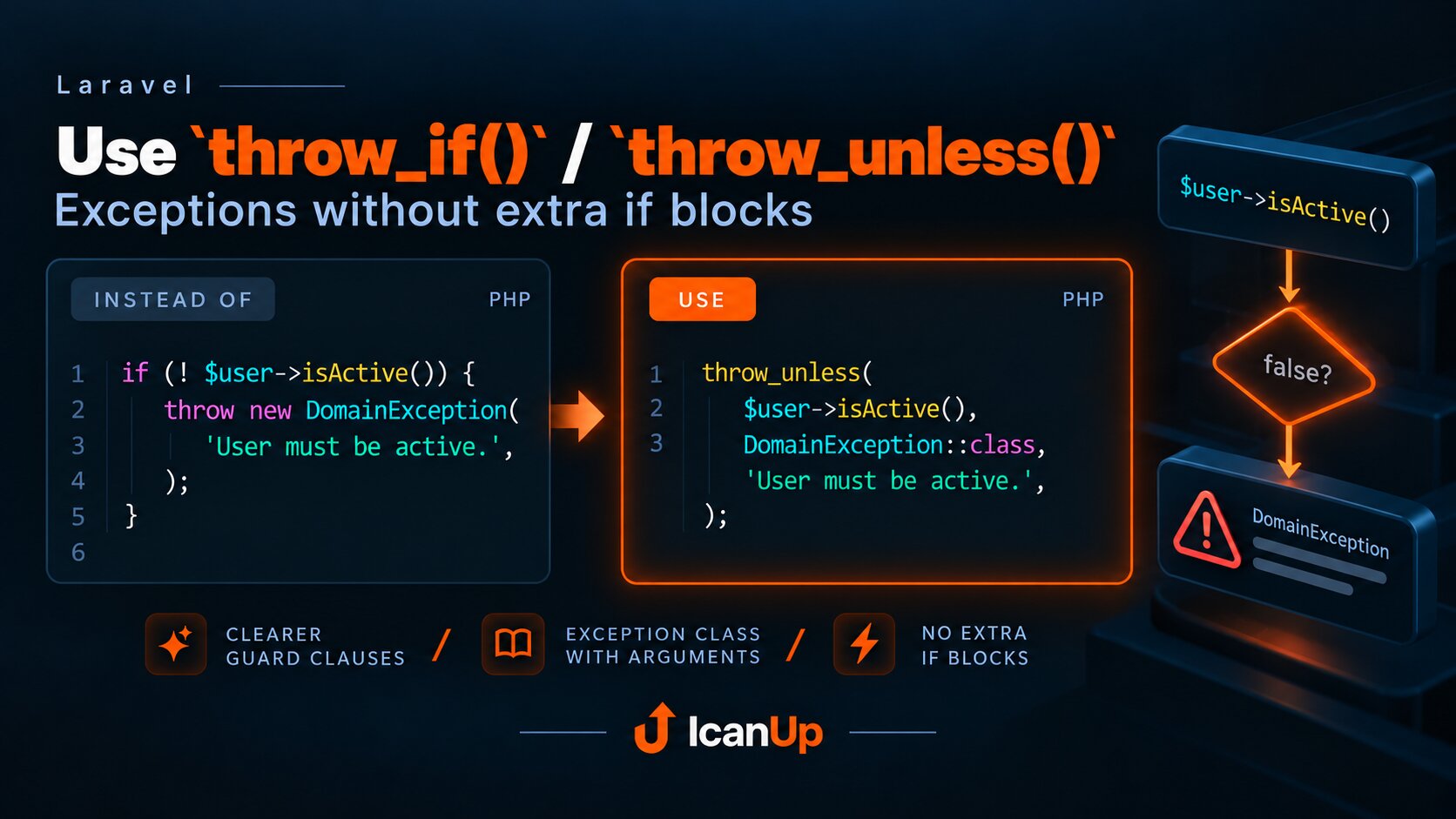
Laravel throw_if() / throw_unless(): Exceptions Without Extra if Blocks
Replace simple if + throw blocks with throw_if() or throw_unless(), choose the form that avoids double negatives, pass exception classes with constructor arguments, and keep guard clauses readable.
A guard check often has a very simple meaning: if a required condition is violated, execution must not continue. In plain PHP, an if followed by throw is a natural way to express that.
When the check is only one simple branch, Laravel can make the intent even more explicit with throw_if() or throw_unless().
Replace a Simple if + throw
if (! $user->isActive()) { throw new DomainException( 'User must be active.', );}throw_unless( $user->isActive(), DomainException::class, 'User must be active.',);Both forms stop execution when the user is inactive. But throw_unless() reads like a compact rule: continue only when the user is active.
This is especially useful near the beginning of a method, where several guards determine whether the main operation may run at all.
throw_if() and throw_unless() Describe the Condition from Different Sides
throw_if( $order->isCancelled(), DomainException::class, 'Cancelled order cannot be processed.',); throw_unless( $user->isActive(), DomainException::class, 'User must be active.',);Pass an Exception Class and Its Constructor Arguments
final class InactiveUserException extends DomainException{ public function __construct(int $userId) { parent::__construct( "User {$userId} must be active.", ); }} throw_unless( $user->isActive(), InactiveUserException::class, $user->id,);The second argument may be an exception class name. When the condition requires an exception, Laravel instantiates that class and forwards the remaining arguments to its constructor.
This works well with domain-specific exceptions whose class name communicates the reason for stopping more clearly than a generic RuntimeException.
The Helper Also Accepts an Exception Instance or Plain Message
throw_if( $order->isLocked(), new LogicException('Order is locked.'),); throw_if( $quantity < 1, 'Quantity must be greater than zero.',);You may pass an already constructed exception object. If the second argument is a plain message string, Laravel throws a RuntimeException containing that message.
A dedicated exception class is often a stronger contract for domain rules, while a short message can be sufficient for a local technical guard.
Several Independent Rules Read Well as Guard Clauses
throw_unless( $user->isActive(), InactiveUserException::class, $user->id,); throw_if( $order->isCancelled(), OrderCancelledException::class, $order->id,); throw_unless( $order->canBeProcessed(), OrderCannotBeProcessedException::class, $order->id,The main operation remains at the bottom without extra nesting. Every line before it answers one question: which condition must hold for the method to continue?
This style is especially effective when the guards are independent and each one maps to its own exception.
Name a Complex Condition Before Throwing
throw_unless( $user->isActive() && ! $order->isCancelled() && ( $order->belongsTo($user) || $user->isAdmin() ), DomainException::class, 'Order cannot be processed.',);$canProcessOrder = $user->isActive() && ! $order->isCancelled() && ( $order->belongsTo($user) || $user->isAdmin() ); throw_unless( $canProcessOrder, DomainException::class, 'Order cannot be processed.',);throw_if() and throw_unless() do not automatically make a complex expression readable. If the condition is already difficult to scan, give it a name or move the rule into a dedicated method.
These helpers are also not replacements for every Laravel boundary. Use validation for input rules, policies or gates for authorization rules, and consider abort_if() or abort_unless() when the intent is specifically to produce an HTTP status response.
This Is Syntax Compression, Not a New Error-Handling Model
When a Plain if + throw Is Better
- when several actions must happen before throwing;
- when the condition needs explanation and a separate block is easier to read;
- when there is an
elsebranch or several different outcomes; - when important context is lost by compressing the check into one line;
- when a normal
ifis more familiar and clearer for the team.
The value of throw_if() and throw_unless() is not the smallest possible line count. They are useful when a simple guard begins to read like a rule: if this state is forbidden, stop; if this invariant does not hold, stop.