Production Should Begin With the Question "Why Are We Producing This?"
A production order can easily become just another document with a number, date, and quantity.
For me, it should answer much more.
Why are we producing this item? How much is needed? By when? Which specification or recipe version applies? Are materials available? What is already reserved? Is capacity available? How much was actually produced? How much became scrap? What remains unfinished?
For me, a production order connects a business need with the actual manufacturing result.
What I Would Want to Know Before Production Starts
Before release, the business needs more than a product name and quantity.
Demand Source
Customer order, stock replenishment, forecast, internal demand, or another reason.
What We Are Producing
The exact product, variant, version, or another characteristic that affects materials and process.
How Much Is Needed
Planned quantity and, where appropriate, an acceptable variance.
When It Is Needed
The date by which the result must be ready for the next operation or customer.
Which Production Rules Apply
The current specification, recipe, routing, or another set of manufacturing rules.
What Is Missing Before Start
Materials, equipment, people, approval, or another condition that prevents release.
How I Would Design a Production Order
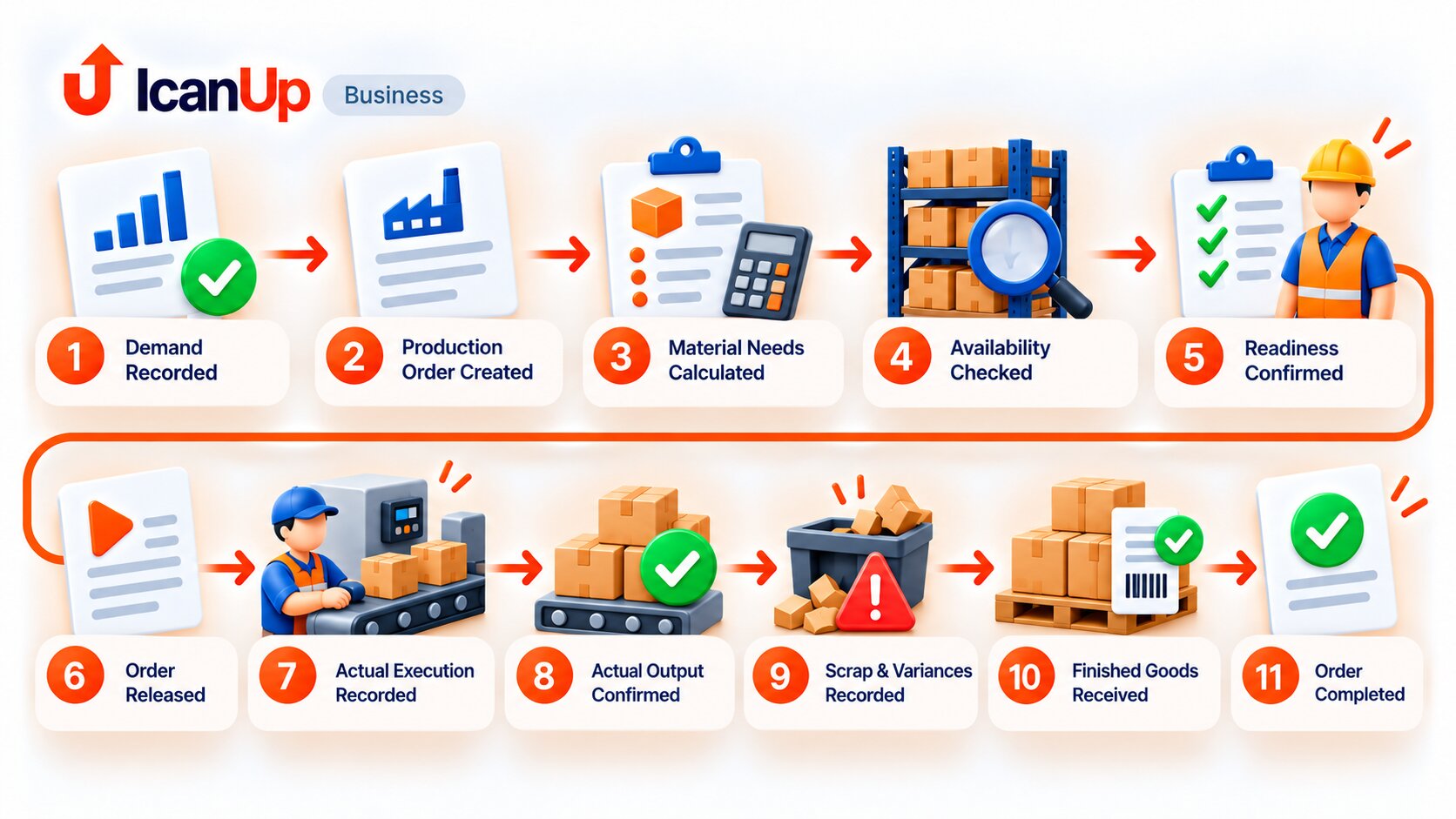
I would keep planning, readiness, actual execution, and completion separate.
Demand Recorded
It is clear why the product is needed, how much is required, and by when.
Production Order Created
The product, planned quantity, manufacturing rules, and connection to the demand source are defined.
Material Requirements Calculated
The system determines planned material and resource quantities according to current rules.
Availability Checked
The business can see what exists, what can be reserved, and what needs purchasing, transfer, or preparation.
Readiness Confirmed
Critical conditions are met or a responsible person makes a controlled decision to proceed.
Order Released to Production
The work moves from planning into actual execution.
Actual Execution Recorded
Materials, stages, time, quantities, and other meaningful facts reflect what really happens.
Actual Output Confirmed
The real finished quantity is recorded instead of automatically assuming the plan was achieved.
Scrap and Other Variances Recorded
Differences between plan and result remain visible instead of disappearing into manual corrections.
Finished Goods Received
Confirmed output moves into the appropriate inventory or next operational state.
Production Order Completed
Plan, actual output, materials, unfinished quantities, and variances are reconciled.
| Measure | Plan | Actual |
|---|---|---|
| Production quantity | 100 units | 100 units planned |
| Material A | 200 kg | 204 kg consumed |
| Material B | 50 kg | 49 kg consumed |
| Finished goods | 100 units | 96 units |
| Scrap | 0 | 3 units |
| Unfinished | 0 | 1 unit |
I would not treat a production order as ready to start simply because it was created.
Critical conditions may exist: materials need to be available, the correct specification version must be active, equipment or people may already be committed to other work, and a certain operation may require approval.
At the same time, I would not try to block every exception.
If the business consciously starts production with incomplete materials or another known risk, that may be a valid decision. But the reason and responsible person should remain visible.
Production Completion Does Not Always Have One Result
A single production order can end with several actual outcomes.
Finished Goods
Quantity that meets requirements and can move to the next operation, inventory, or a customer order.
Scrap
Output that does not meet requirements and needs a separate reason or decision.
Work in Progress
Part of the work is complete, but the result is not yet finished goods.
Rework
A product or intermediate result may need another operation instead of becoming final scrap.
By-product
Some processes produce additional materials or outputs with further value that should not disappear from control.
Variance
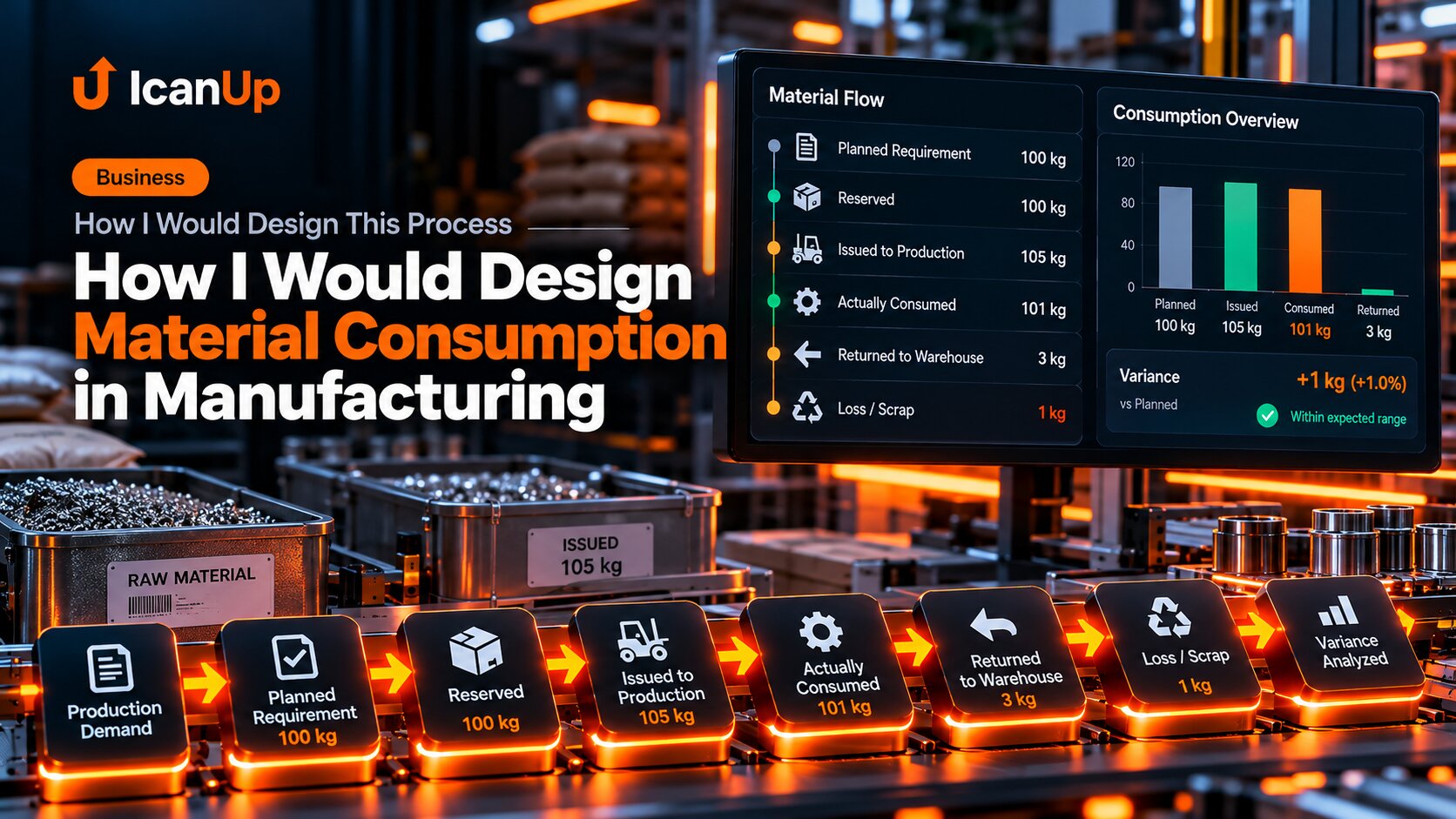
The difference between plan and actual result that can be analyzed instead of manually balanced away.
I would not close a production order automatically with the quantity that was planned at the beginning.
If the plan was 100 units and the actual result is 96 finished, 3 scrap, and 1 unfinished, that is the real outcome.
The system should not pretend 100 were produced simply because 100 appeared in the original plan.
The business can then decide whether to create another production order for 4 units, accept 96, or finish the remaining unit later.
The plan answers "what did we want to produce"; actual output answers "what did we really produce".
A Few Questions About Production Orders
The main principle is to keep production demand, the plan, and the actual result separate.
Where can a production order come from?
Should materials be reserved immediately after order creation?
Can production start when some materials are missing?
What if actual output is lower than planned?
Should finished goods automatically appear in inventory?
Where should analysis of the current process begin?
How I Would Design This Business Process
In this series, I break down real business processes from the reason they begin to the actual result so plans, execution, and variances do not live in separate spreadsheets and messages.

Is It Also Difficult to Explain Why a Production Order Started and What It Actually Produced?
Take several recent production orders and trace the full path: demand source, plan, materials, release, actual execution, finished goods, and variances. If those parts have to be reconstructed from different spreadsheets and people, the process is already worth examining.