Stock Does Not Teleport From One Warehouse to Another
On paper, a transfer looks simple: subtract 20 from warehouse A and add 20 to warehouse B.
In real life, an hour, a day, or several days may pass between those two events.
The goods need to be located, reserved for transfer, picked, checked, dispatched, transported, counted at the destination, and only then made available.
If the system immediately adds them to the destination warehouse, sales may promise stock that has not physically arrived. If the goods remain available at the source until receipt, another employee may sell stock that has already left.
For me, there must therefore be a third state between the two warehouses: goods in transit.
Which Inventory States I Would Keep Separate
These do not necessarily need separate tables or screens, but the business should understand the difference between these facts.
At the Source Warehouse
The goods physically remain at the source and have not yet entered the transfer process.
Reserved for Transfer
The goods are still physically present but should no longer be used for another order or transfer.
In Picking
Warehouse employees are physically preparing the goods for this transfer.
In Transit
The goods have left the source warehouse but the destination has not yet confirmed receipt.
Received
The destination warehouse has physically received and confirmed the actual quantity.
Available at Destination
After receipt and required checks, the goods can be used for sales or other operations.
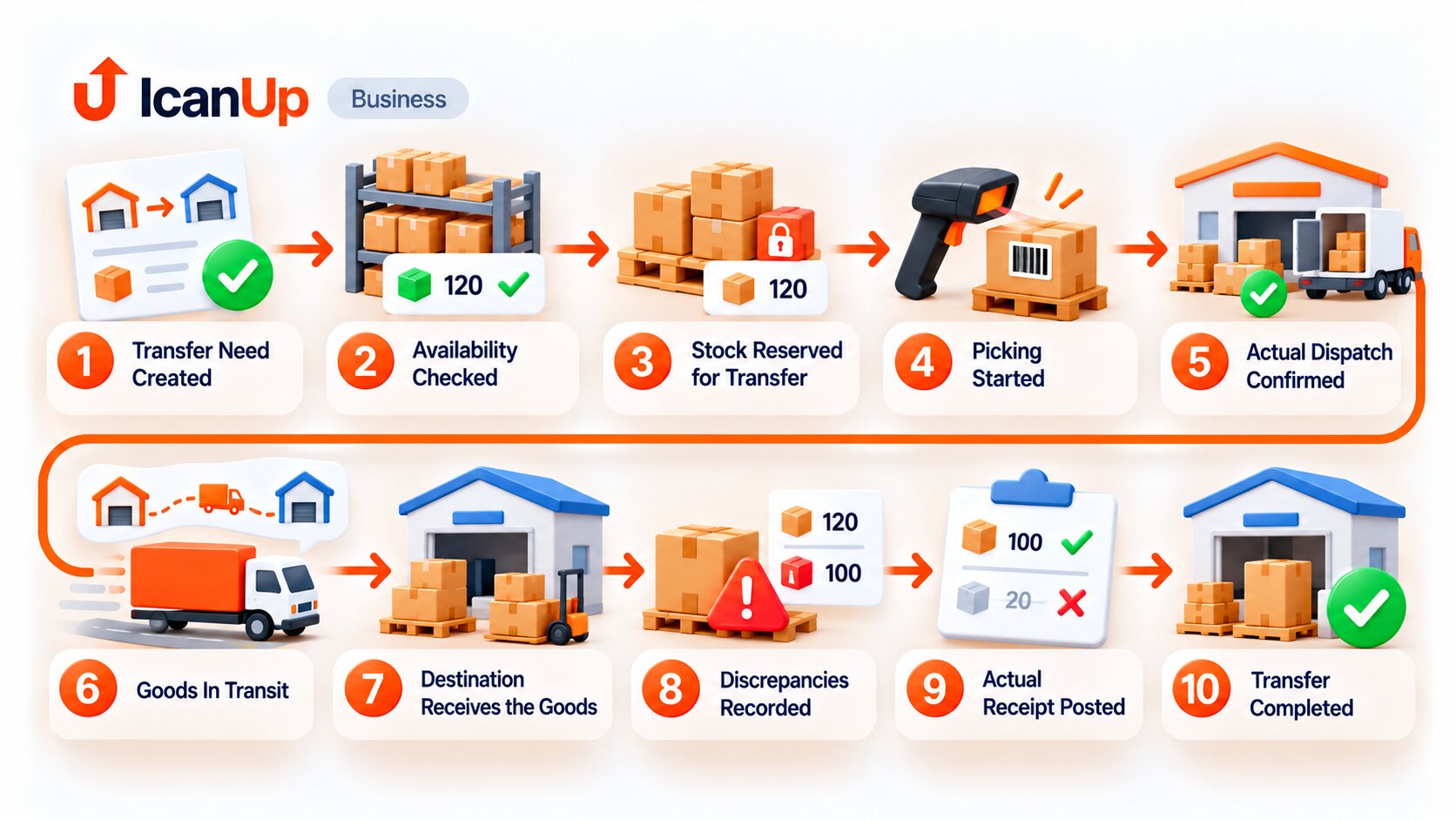
How I Would Design a Transfer Between Warehouses
I would record the need, actual dispatch, and actual receipt separately. That prevents stock from moving between warehouses before the goods themselves do.
Transfer Need Created
The system knows which product, quantity, source warehouse, and destination are involved.
Availability Checked
The source warehouse checks not only physical stock but reservations and other confirmed needs.
Stock Reserved for Transfer
The required quantity is no longer considered free for new operations.
Picking Started
A warehouse employee receives a specific task and physically prepares the required items.
Actual Dispatch Confirmed
The system records exactly what and how much actually left the source warehouse.
Goods Become In Transit
They are no longer source warehouse stock but are not yet available at the destination.
Destination Receives the Goods
The receiving employee verifies actual quantity and, where needed, item condition.
Discrepancies Recorded
If 20 units were dispatched and 19 arrived, the system should not silently complete the transfer as 20.
Actual Receipt Posted
The confirmed quantity becomes inventory at the destination warehouse.
Transfer Completed
Dispatched, received, and problematic quantities are reconciled while the full operation history remains visible.
| Event | Warehouse A | In Transit | Warehouse B |
|---|---|---|---|
| Before transfer | 100 | 0 | 20 |
| 30 reserved | 100 physical, 70 available | 0 | 20 |
| 30 dispatched | 70 | 30 | 20 |
| Warehouse B receives 28 | 70 | 2 require investigation | 48 |
| Discrepancy resolved | 70 | 0 | Final quantity follows the confirmed decision |
The "in transit" state matters for more than accurate inventory.
It also answers business questions: how much stock is currently moving between locations? Which transfers should already have arrived? Who is responsible for the goods at this stage? Which orders at warehouse B depend on this incoming transfer?
If a transfer takes longer than usual, that can become an exception requiring attention.
Goods in transit should not disappear from control simply because they temporarily sit on no warehouse shelf.
Transfers Can Begin for Different Reasons
I would preserve the reason because it helps explain priority and the next steps.
Customer Order Demand
Warehouse B does not have enough stock for a specific confirmed customer order.
Stock Replenishment
One warehouse has excess inventory while another needs to maintain a working stock level.
Seasonal or Regional Demand
Stock moves toward the location where higher demand is expected.
Product Return
Goods may move back to a central warehouse, inspection location, or another specialized destination.
Production Demand
Materials move to the location where they are needed for a specific manufacturing process.
Internal Rebalancing
The business redistributes stock between locations before one warehouse reaches a critical shortage.
A separate question is whether goods can be promised to a customer at the destination before they physically arrive.
I would not mix that with currently available inventory.
For example, sales might see: 5 units available now and another 20 in a confirmed transfer expected tomorrow.
The business may allow orders against incoming stock. But the customer is then being promised a different reality: the stock is expected, and fulfillment depends on successful completion of the transfer.
A Few Questions About Transfers Between Warehouses
The main principle is that dispatch should not automatically mean receipt.
When should source warehouse stock decrease?
When should destination warehouse stock increase?
What are goods in transit?
What if fewer units arrive than were dispatched?
Can goods in transit be sold?
Where should improvement begin?
How I Would Design This Business Process
In this series, I separate expectations, decisions, and actual operations in real business processes so people do not have to reconstruct the current state manually.

Does Stock Sometimes "Disappear" Between Your Warehouses for a Day or Two?
Take several recent transfers and check three moments: when the goods stopped being available at the source, where they existed before actual receipt, and when they became available at the destination. If that state has to be reconstructed from chats or spreadsheets, the process is worth examining.