
Issuing Material to Production Does Not Mean All of It Was Consumed
In a simple model, the business can take planned material usage, multiply it by expected output, and consume the result immediately.
Real manufacturing is often more complicated.
Some material may be issued but not used. Additional consumption may occur. Some may become scrap. Unused material may return to inventory. Actual output may differ from the original plan.
If all of those cases are reduced to one automatic standard consumption, the system may show a clean number without showing reality.
I would therefore keep planned usage, physical material movement, and actual consumption separate.
Which Quantities I Would Keep Separate
For one production order, the same material can have several meaningful quantities.
Planned Requirement
How much material is expected according to the plan, recipe, specification, or another business rule.
Reserved
How much is committed to this production need and should not be promised elsewhere.
Issued to Production
How much physically left warehouse stock and was handed over for production work.
Actually Consumed
How much was genuinely used by or became part of the production process.
Returned
What was issued but not used and physically returned to available warehouse stock.
Variance
The difference between expected and actual usage that should remain visible instead of being hidden by manual balancing.
How I Would Design Material Flow in Manufacturing
The exact moment of final consumption depends on the business. But I would not mix planning, warehouse issue, and confirmed usage.
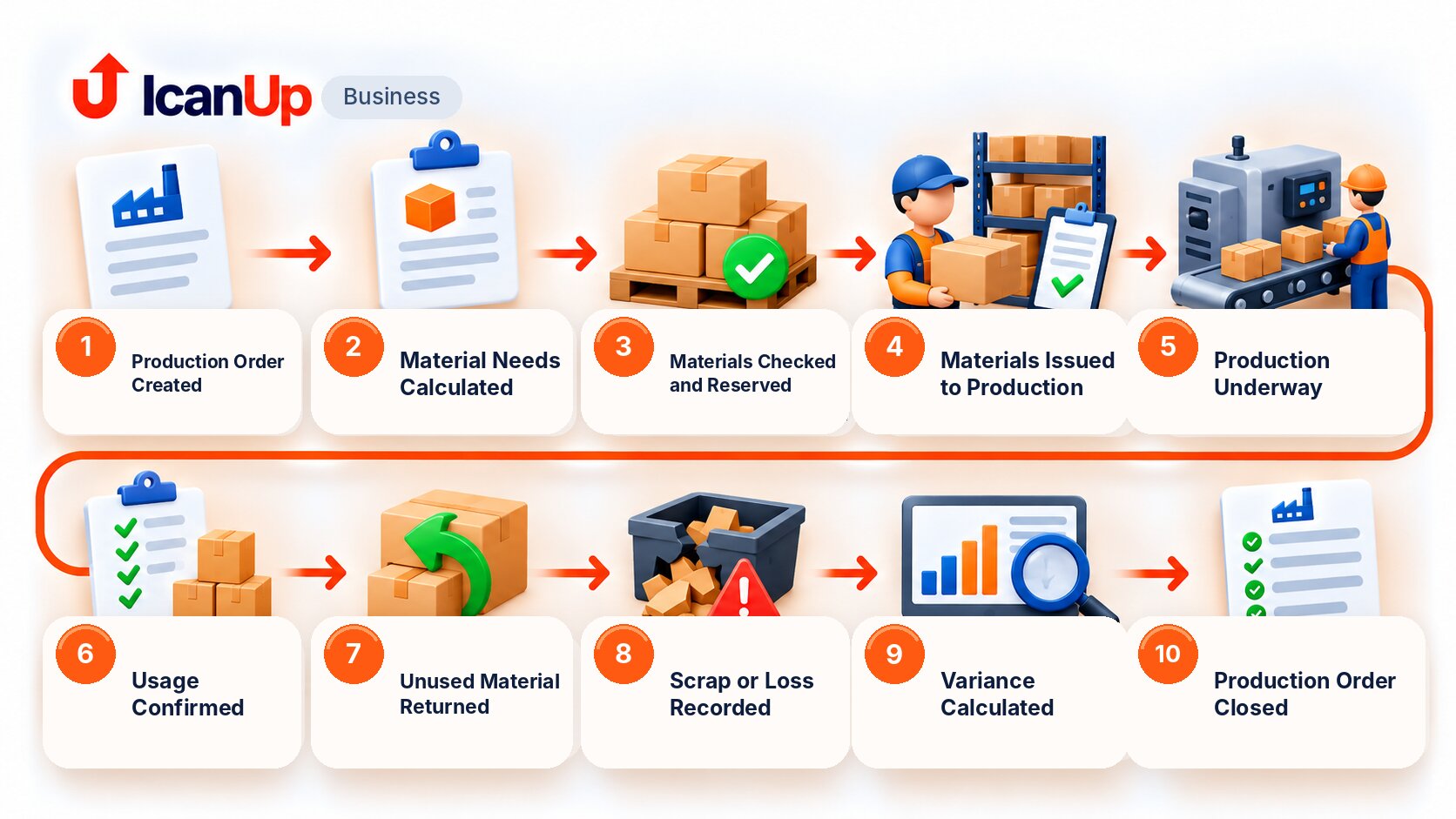
Production Demand Created
The business knows what it plans to produce, in what quantity, and which materials are expected.
Planned Requirement Calculated
The system determines expected material quantities according to the current manufacturing rules.
Materials Checked and Reserved
Demand is compared with available stock and the required quantity can be committed to the production order.
Materials Actually Issued
The warehouse records exactly what, how much, and for which production order was physically handed over.
Production Takes Place
Actual usage may match the plan or differ from it.
Actual Consumption Confirmed
The real quantity consumed within the production operation is recorded.
Unused Material Returned
Material that physically remains and can still be used returns to the appropriate inventory state.
Scrap or Other Loss Recorded
Quantity that did not become finished output and cannot return as usable material receives its own reason and outcome.
Variance Calculated
Planned and actual consumption are compared so the difference remains visible.
Production Order Completed
Actual output, consumed materials, returns, and variances are reconciled with each other.
| Measure | Quantity | What It Means |
|---|---|---|
| Planned requirement | 100 kg | Expected usage for planned output |
| Issued to production | 105 kg | More than the planned quantity physically handed over |
| Actually consumed | 101 kg | Real material consumption in production |
| Returned to warehouse | 3 kg | Material remained usable |
| Loss / scrap | 1 kg | Requires a separate reason |
| Variance from plan | +1 kg consumption | Should remain visible and may require analysis |
Additional consumption should not automatically mean a problem or employee mistake either.
There can be many reasons: characteristics of a particular material batch, machine setup, a non-standard product, process loss, defect correction, or an actual error.
What matters to me is different: if the plan was 100 kg and actual usage was 108 kg, that difference should not simply disappear into a new inventory balance.
It should be recorded, while the business decides which variances are normal, which require explanation, and which should attract management attention.
Not Everything That Fails to Become Finished Output Has the Same Outcome
After production, remaining material can follow different paths.
Unused Material
It remains physically usable and can return to available warehouse stock.
Process Loss
An expected or acceptable part of the process that should remain visible separately from useful consumption.
Scrap
Material was consumed but the result did not meet expectations and requires its own reason.
Reuse
Some remaining material or by-products may retain value and move into another controlled state.
I would not show a production manager only the total amount of material consumed.
It is much more useful to see where actual usage repeatedly exceeds the plan, where material is frequently returned, which items often require extra issue, where scrap appears, and which production orders show unusual variance.
One large number for "materials consumed this month" does not explain where a problem or improvement opportunity actually exists.
A variance becomes useful only when it can be connected to a specific process.
A Few Questions About Material Consumption in Manufacturing
The main principle is that planned requirement, physical issue, and actual consumption should not automatically be treated as the same thing.
Can materials be consumed automatically according to a standard?
Does warehouse issue mean the material is already consumed?
What should happen to unused material?
What about excess consumption?
Does every variance need an explanation?
Where should improvement begin?
How I Would Design This Business Process
In this series, I break down real business processes and separate plans from actual operations so variances become useful information instead of a reason for manual data correction.

Does Your Manufacturing Team Also Have to "Fix" Material Balances After Production?
Take several production orders and compare four things: planned material, actual issue, real consumption, and what was returned. If inventory still has to be corrected manually afterward, the process is already worth examining.