Stock in the Warehouse Does Not Automatically Mean Stock You Can Promise to a Customer
The reservation problem usually becomes visible not when stock is absent, but when the system says stock exists even though the company has already promised it to another customer.
For example, 20 units physically exist in the warehouse. Twelve are already reserved for one order and another five for a second order. Only three are genuinely available for a new sale.
If sales sees only physical inventory, another customer may be promised stock that is no longer freely available.
For me, physical stock and available stock are different business facts.
Which Quantities I Would Keep Separate
A single "stock" number often hides several different inventory states.
Physical Stock
How many units physically exist in the warehouse right now.
Reserved
How many units are already committed to specific orders or other confirmed needs.
Available
How much can genuinely be promised to a new customer after current reservations are considered.
Expected
What has been ordered from a supplier or is planned to arrive but is not yet physical inventory.
In Picking
Stock already being physically prepared for a specific order and moving toward shipment.
Unavailable for Sale
Stock may physically exist but be under inspection, damaged, or in another condition that prevents sale.
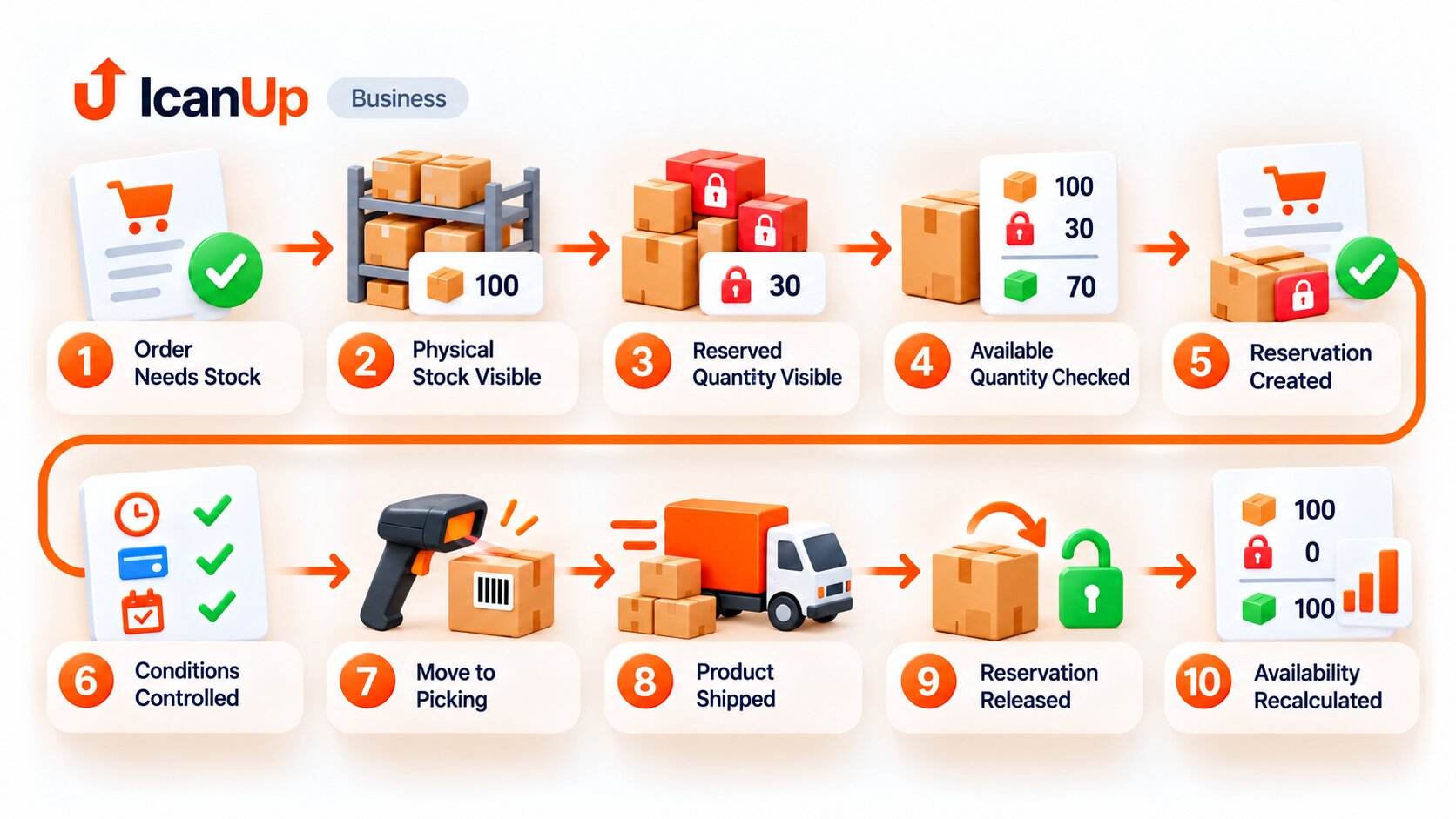
How I Would Design the Reservation Lifecycle
A reservation should not be a number someone manually adds to a spreadsheet. It should have a reason, a clear beginning, and a clear end.
Order Requires Stock
The system knows the exact item, quantity, warehouse, or another fulfillment location.
Available Quantity Checked
The decision uses more than physical stock and includes existing reservations and unavailable inventory.
Reservation Created
A specific quantity is connected to a specific order or another confirmed demand.
Available Stock Reduced
The item remains physically in the warehouse but should no longer be offered as free stock to another customer.
Reservation Conditions Controlled
Where required, the reservation can depend on an expiration date, payment, customer confirmation, or another condition.
Reservation Moves Into Picking
When the order is ready for fulfillment, the warehouse begins physically preparing the reserved stock.
Product Shipped
Physical inventory decreases and the reservation is completed by the actual shipment.
Or Reservation Released
If the order is cancelled, the deadline passes, or another condition fails, the quantity can become available again.
| State | Quantity | What Sales Sees |
|---|---|---|
| Physically in warehouse | 20 | 20 units physically exist |
| Reservation for order A | 12 | These 12 are no longer free |
| Reservation for order B | 5 | Another 5 are already committed |
| Available for new sale | 3 | Only 3 can be confirmed to a new customer |
| Expected from supplier | 30 | Can be shown separately but is not physical stock yet |
For one business, reservation may begin immediately after order confirmation. For another, only after prepayment. A third company may hold stock for a few hours while the customer completes checkout.
I would therefore not build a universal rule that every order automatically reserves stock.
The business needs to answer several questions: what is enough to create a reservation? How long does it remain active? What extends it? Who can release it manually? What happens after partial payment or a quantity change?
A reservation should represent a real business promise to the customer.
I would also avoid an all-or-nothing reservation model.
A customer may order 100 units while only 60 are currently available. That does not necessarily mean the order is impossible.
The business can reserve 60 and mark the remaining quantity as uncovered demand. It can then decide whether to wait for supply, create a purchase request, offer an alternative, or agree on partial shipment.
Sales then sees more than a red "insufficient stock" message. It sees which part of the order is already covered and how much is still missing.
Exceptions I Would Design for From the Beginning
Reservations become truly interesting not in the normal case, but when several customers compete for limited stock.
Quantity Change
If the customer reduces the order, excess reserved stock should become available again instead of remaining hidden.
Cancellation
When an order is cancelled, its reservation should end according to a defined rule.
Overdue Payment
If reservation depends on payment, the business needs a rule for what happens when the deadline is missed.
Priority Customer
If the business allows reprioritization, it should be an explicit decision instead of silently moving stock between orders.
Partial Reservation
The order should show which quantity is covered and which quantity still waits for stock.
Multiple Warehouses
The business needs to know not only the total quantity but where the reserved stock is physically located.
A Few Questions About Product Reservation
The main purpose of a reservation is to prevent the company from quietly promising the same quantity to several customers.
How is reservation different from removing stock?
When should a reservation be created?
Should reservations expire?
What if there is not enough stock for the whole order?
Can stock be moved from one customer reservation to another?
Where should improvement begin?
How I Would Design This Business Process
In this series, I break down real business processes and show which facts, rules, and exceptions I would make visible instead of relying on manual coordination between people.

Does Your Warehouse Show Stock While Sales Still Has to Ask What Can Be Sold?
Take several products and check three numbers: how much physically exists, how much is already reserved, and how much is genuinely available for a new order. If the answer has to be reconstructed from spreadsheets, chats, and people’s memory, the process is already worth examining.