
One Localization System for Ukrainian and English ICanUp
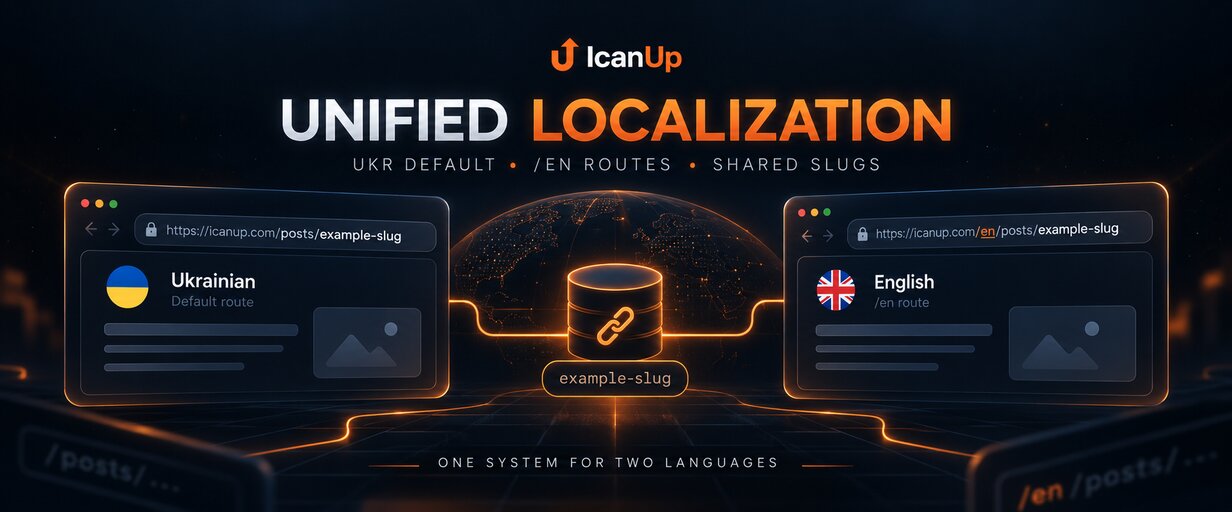
ICanUp moved to one localization infrastructure: Ukrainian remained the default locale without a prefix, English uses /en, and all public routes gained one shared locale-aware routing contract.
Multilingual support existed in ICanUp from the beginning, but as the site grew, it became important not to leave localization as a collection of separate conditions spread across the application.
In August 2026, public localization moved to one infrastructure based on AVN Laravel Localization.
The goal was simple: one set of rules for route registration, locale resolution, language switching, canonical URLs, and public links across the project.
The URL structure became predictable
Ukrainian Without Prefix
English Through /en
Locale from URL
Canonical Redirects
Shared slugs became part of the multilingual model
Another important decision was moving Posts and Categories to one product-owned slug shared across locales.
Ukrainian and English URLs now differ by the locale prefix rather than by two independent slugs.
The same entity therefore keeps a stable URL identity:
/posts/example-slug/en/posts/example-slug
This simplified language switching, sitemap generation, RSS, hreflang, and internal link generation.
Language switching stopped being a collection of exceptions
Route Parameters
Query Parameters
Strict Locale Handling
Stable Route Names
Localization became infrastructure, not a page-level feature
After the integration, the homepage, posts, categories, pages, and other public routes began using one locale-resolution mechanism.
At the same time, Admin, API, authentication, webhooks, and service routes remained outside the public localization layer and did not gain unnecessary dependencies.
It was also important that localized routes continued to work correctly with Laravel route cache and application optimization.
This decision became an important foundation for the next stages of ICanUp.
New Pages, Series, Forms, News, and other public modules could now connect to an existing locale-aware routing contract instead of implementing their own localization rules.
From this point on, the Ukrainian and English versions of ICanUp became two representations of one system rather than two parallel sets of routes.