
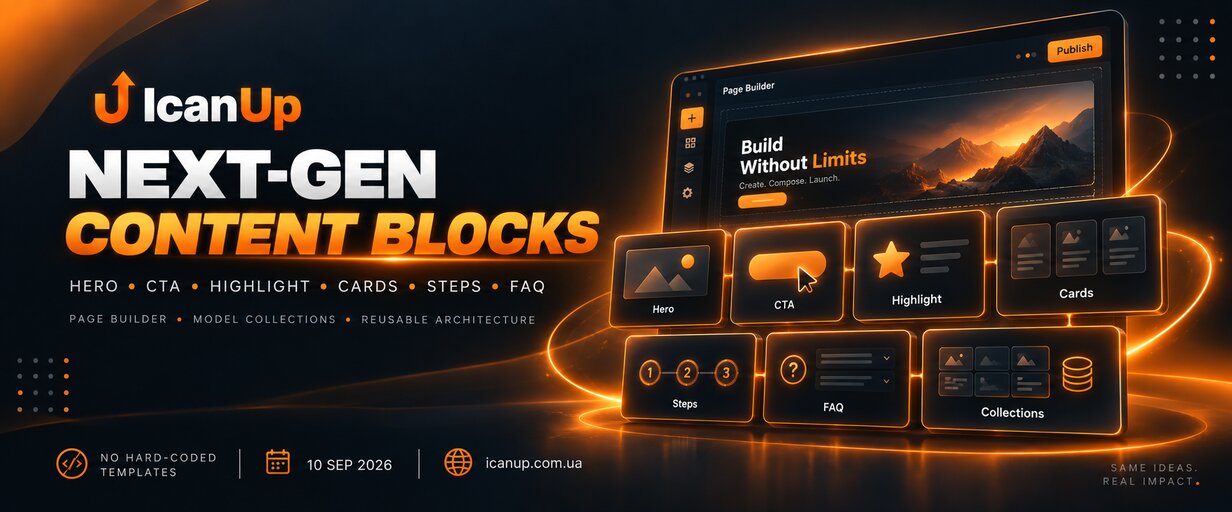
ICanUp Page Builder Gained a New Generation of Content Blocks
ICanUp gained reusable Hero, CTA, Highlight, Cards, Steps, and FAQ blocks, multiple presentation variants, and a generic Model Collection architecture. Complex presentation pages can now be built without dedicated hard-coded templates.
The first ICanUp Pages could already be composed from content blocks, but those blocks primarily solved the basic problem of placing text, headings, images, and other standard content.
In September 2026, that system took its next major step.
ContentBlocks began defining not only page content but also composition: hero sections, cards, process steps, highlights, calls to action, FAQ sections, and dynamic collections.
New blocks for presentation pages
Hero
CTA
Highlight
Cards
Steps
FAQ
Presentation variants became part of the system
The new blocks are not tied to a single visual representation.
The architecture separates content from presentation configuration such as alignment, spacing, media, action placement, and supported variants.
Variants are intended to represent different use cases rather than minor cosmetic CSS changes.
The same block type can therefore appear in multiple contexts without creating a page-specific copy.
Model Collections became a generic block
Automatic Collection
Manual Collection
Cards
Compact
Featured
Model-Agnostic Architecture
The builder remained safe and predictable
Generic configuration does not mean a Page can submit arbitrary PHP classes or unrestricted query options.
Each supported collection type is explicitly registered and owns its allowed filters, sorts, layouts, and public presentation rules.
This keeps the generic block independent from individual models and avoids turning the central component into a long chain of model-specific conditions.
Services became the first major real-world test
The new architecture was validated by more than isolated components.
The complete Ukrainian and English Services Page was assembled through the standard ICanUp Page architecture.
It uses Hero, Cards, process Steps, Highlight sections, CTAs, FAQ, and other reusable blocks.
No Services-specific hard-coded public template was introduced. The same mechanism can later build About pages, landing pages, product presentations, and other rich public sections.
The new blocks remained part of the shared platform
The richer presentation capabilities did not create a separate builder exclusively for Services.
Ukrainian and English content continues through the shared ContentBlock localization pipeline. Public rendering supports responsive layouts, light and dark themes, and accessibility requirements.
Pages also continue to reuse the existing ICanUp SEO infrastructure including canonical URLs, hreflang, Open Graph, breadcrumbs, and sitemap integration.