
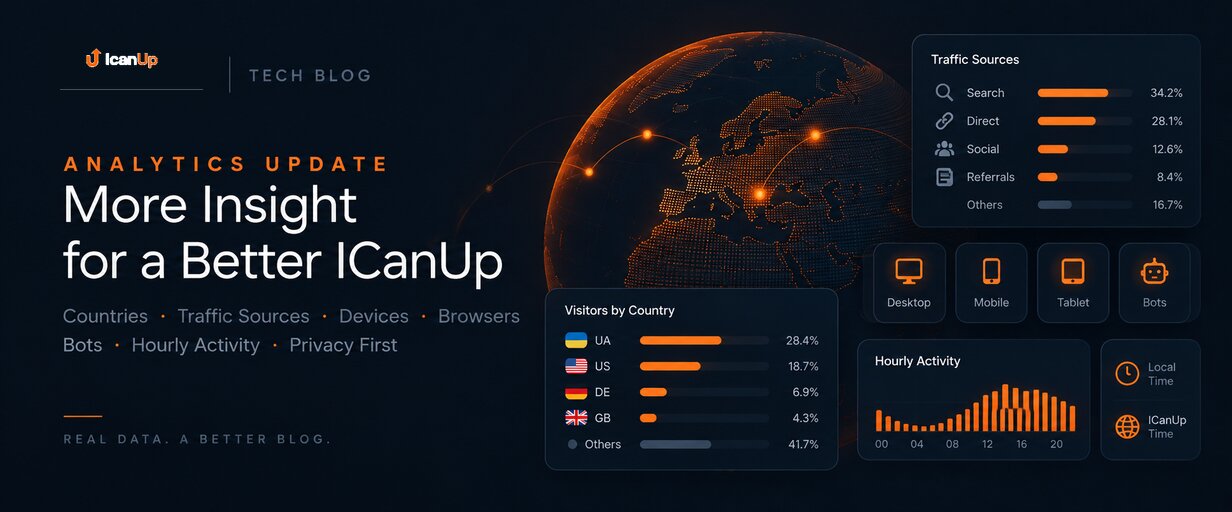
ICanUp Analytics Expanded with Countries, Traffic Sources, Devices, Bots, and Activity Time
ICanUp analytics expanded with countries, devices, browsers, operating systems, traffic sources, human and bot classification, referral domains, and hourly activity without storing raw IP addresses.
The first version of ICanUp analytics already answered the basic questions: what content is being read, how many views it receives, which locale is used, and how activity changes by day.
The next step was understanding the context behind those views: where readers come from, which devices they use, which external sources send traffic, how much activity belongs to bots, and when that activity happens.
By the end of August and the beginning of September 2026, ICanUp analytics gained this deeper level of detail.
What became visible
Countries
Devices
Browsers and Operating Systems
Traffic Sources
Humans and Bots
Referral Domains
Country is resolved at the infrastructure boundary
ICanUp does not send an IP address to an external GeoIP service on every page view and does not store raw IP addresses in analytics history.
Country resolution happens at a trusted infrastructure boundary. Laravel receives only a normalized two-letter country code.
A browser cannot simply provide its own trusted country value because the infrastructure creates or overwrites that internal header.
Analytics stores stable values such as UA, US, or DE, while localized country names are resolved at presentation time.
Traffic sources became more useful
Direct
Search and Social
External Referrals
UTM Context
Bots no longer have to be mixed with the real audience
A significant part of public web traffic can come from search crawlers, link-preview services, automated scanners, AI crawlers, and other technical clients rather than people.
ICanUp began separating human and bot-classified traffic so large totals would not create a misleading picture of the actual reading audience.
Bot traffic also gained a bounded crawler-family dimension for supported search crawlers, preview bots, known AI crawler families, and safe fallback categories.
The full raw User-Agent does not need to be stored as an analytics value.
Analytics gained an hourly time dimension
Hourly Activity
Visitor Local Time
ICanUp Reporting Time
Honest Data Coverage
Country is intentionally not treated as a timezone. This matters especially for countries such as the United States, where one country spans multiple time zones.
Visitor local hour is calculated only when a privacy-safe time signal is available for that view, while reporting hour is tracked separately in the canonical ICanUp reporting timezone.
This makes it possible to answer two different questions: when readers are active in their own local time, and when that activity happens relative to ICanUp reporting time.
By September 2, 2026, ICanUp analytics had grown from basic view measurement into a much deeper audience, traffic, bot, referral, and time-analysis system without abandoning the principle of data minimization.